September 4, 2026
Why Small Language Models Are the Future of Work
Discover how deploying local small language models helps your enterprise slash cloud costs, ensure absolute data privacy, and achieve ultra-low latency.
The Rise of Small Language Models: Why Your Enterprise Needs Local SLMs
For the past two years, the enterprise AI playbook has been dominated by a single, expensive philosophy: bigger is better. Leaders rushed to integrate massive, cloud-hosted Large Language Models (LLMs) with hundreds of billions of parameters into their workflows. However, as organizations transition from experimental pilots to production-grade systems, they are encountering three major barriers: soaring cloud API bills, unacceptable latency, and critical data privacy risks.
A quiet revolution is happening at the edge of artificial intelligence. Small Language Models (SLMs), defined generally as models with fewer than 15 billion parameters, are proving that enterprise utility does not require massive scale. By deploying highly optimized, local small language models, enterprises can reclaim ownership of their data, slash operational expenses, and build hyper-specialized AI systems tailored to their specific workflows.
Understanding the Shift: What Are Small Language Models?
To understand why SLMs are gaining rapid traction, we must first look at how language models are built. Traditional frontier models like GPT-4 or Claude 3 are trained on massive, unstructured crawls of the entire internet. They contain vast amounts of general knowledge, from historical trivia to pop culture references, which makes them highly versatile but incredibly resource-intensive.
Small Language Models take a different approach. Instead of maximizing parameters, creators of SLMs focus on training models on highly curated, high-quality textbooks, synthetic data, and specialized domain knowledge. By filtering out the noise of the open web, these smaller architectures learn core reasoning patterns, grammar, and logical structures without the overhead of storing encyclopedic trivia.
Key Insight: Traditional LLMs try to know everything about everything, from 18th-century poetry to quantum physics. Enterprise SLMs, by contrast, focus on doing a handful of high-value tasks with absolute precision, utilizing highly curated training datasets to punch far above their weight class.
This shift in training methodology means that an 8-billion parameter model today can often match or outperform a 70-billion parameter model from just a year ago on specific business tasks like document summarization, entity extraction, structured data formatting, and code generation.
Comparative Analysis: Enterprise LLMs vs. Local SLMs
When choosing an AI architecture, engineering and product teams must balance tradeoffs across performance, privacy, and budget. The table below outlines how local small language models compare to massive, cloud-hosted alternatives.
| Capability / Dimension | Massive Cloud LLMs (SaaS API) | Local Small Language Models (SLMs) |
|---|---|---|
| Parameter Size | 100B to 1T+ parameters | 1B to 15B parameters |
| Primary Hosting | Public Cloud (SaaS API) | On-Premises, Private VPC, or Edge Devices |
| Inference Cost | High (variable, per-token billing) | Minimal (fixed hardware amortization) |
| Data Privacy | High-risk (data routed to third-party APIs) | Total control (data never leaves your network) |
| Latency | Variable (dependent on network & queue times) | Ultra-low (sub-millisecond local execution) |
| Customization | Limited (basic prompting or expensive RAG) | Deep (unrestricted fine-tuning & weight access) |
The Core Business Drivers for Enterprise SLM Deployment
Deploying an enterprise slm deployment strategy is not just about cutting costs. It is about architectural sovereignty and designing a resilient, high-performance tech stack. Here are the primary business drivers forcing modern enterprises to transition to local execution.
1. Absolute Data Privacy and Compliance
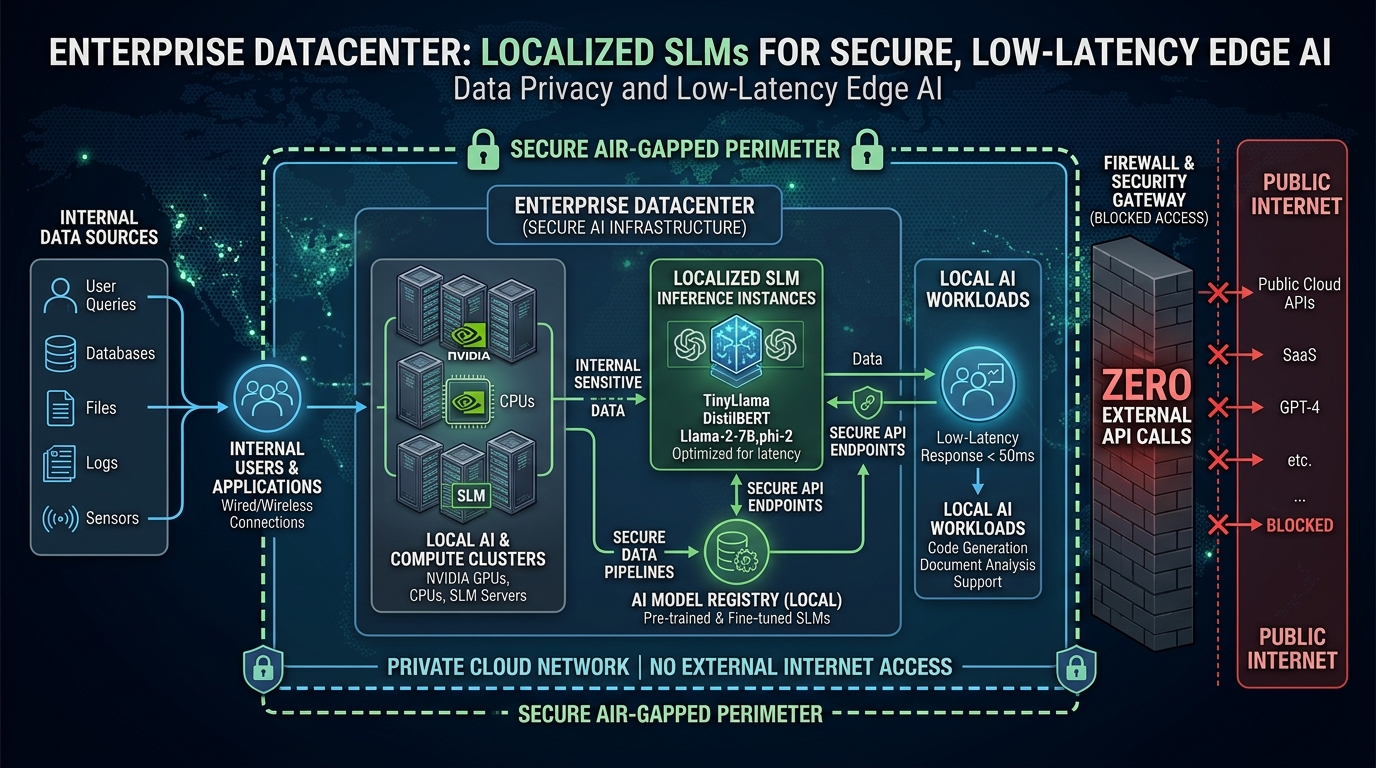
For industries governed by strict regulatory frameworks like healthcare (HIPAA), finance (SEC regulations), or legal services, sending proprietary data or customer records to a third-party API is a compliance nightmare. Local SLMs run entirely within your private cloud environment or local hardware. Because your data never leaves your secure perimeter, you bypass complex vendor risk assessments, eliminate the threat of external data leaks, and ensure total sovereignty over your corporate intellectual property.
2. Radical Cost Reduction at Scale
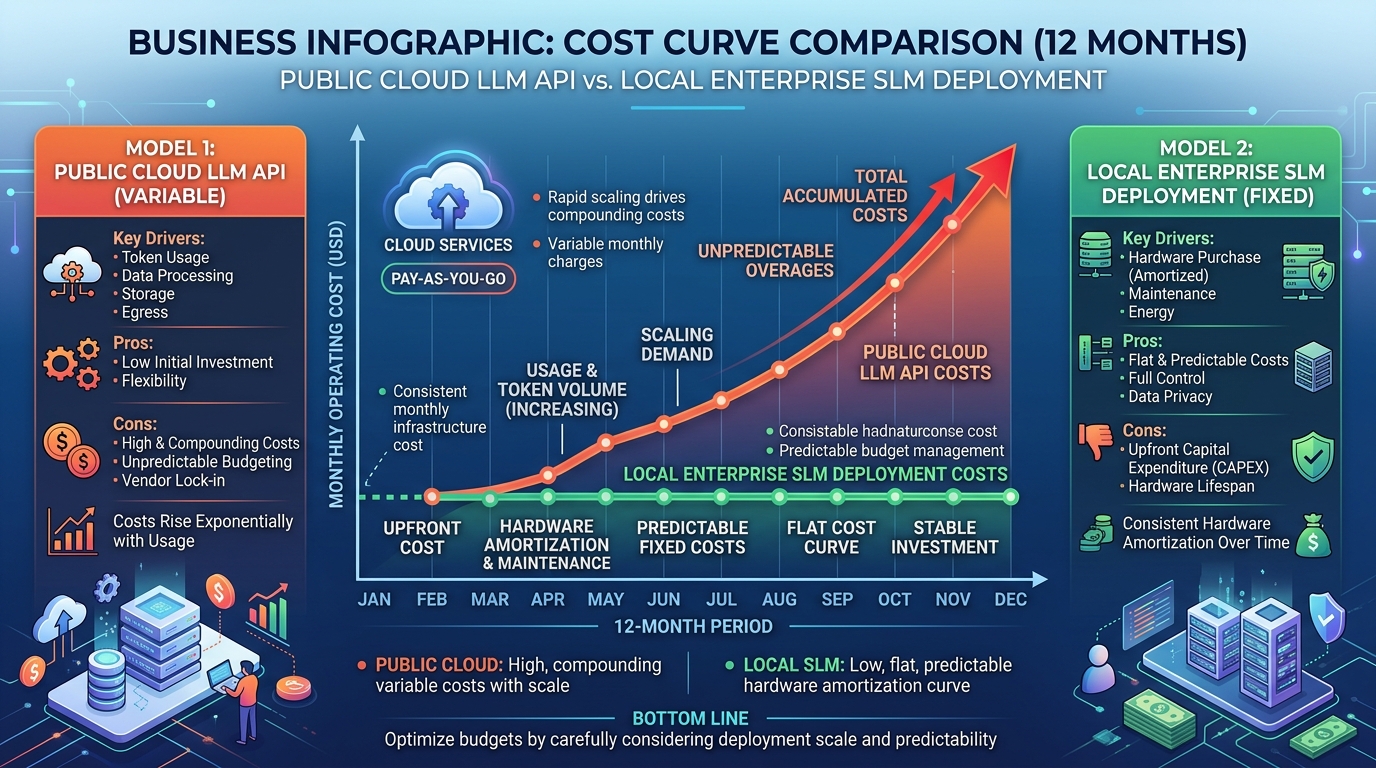
While cloud APIs seem inexpensive during the initial proof-of-concept phase, they become cost-prohibitive once integrated into high-volume, automated business workflows. Local SLMs can run on standard consumer-grade GPUs or cost-effective on-premises hardware.
Instead of paying variable monthly fees to API providers for millions of tokens, organizations can treat local hardware or private VPC instances as a fixed, predictable capital expense. Once the infrastructure is paid for, the incremental cost of running millions of local inferences drops to near zero.
3. Ultra-Low Latency and Offline Edge AI
Many modern applications require real-time processing that cloud models simply cannot deliver due to network round-trip times. By utilizing edge ai for enterprise use cases, organizations can deploy SLMs directly onto local devices, such as warehouse scanners, field laptops, point-of-sale systems, or vehicle consoles. These models execute reasoning tasks in milliseconds, completely independent of internet connectivity.
Top Open-Source SLMs Leading the Market
The rapid evolution of open source slms has democratized access to high-performance AI. Organizations no longer need to build models from scratch; instead, they can build upon foundational open-weights models that have been pre-trained by the world's leading research teams.
-
Meta Llama 3 (8B): Widely regarded as one of the most capable models in its class. With an 8,000-token context window and incredibly strong logical reasoning, it serves as an ideal baseline for most enterprise classification, summarization, and agentic workflows.
-
Microsoft Phi-3 (3.8B to 14B): Engineered specifically to demonstrate how far high-quality training data can push a small model. The Phi-3-Mini (3.8B) model is small enough to run smoothly on modern smartphones, yet it matches models twice its size on logical and mathematical reasoning tasks.
-
Mistral (7B): A highly versatile model that has become a favorite among developers. Known for its speed, low memory footprint, and stellar performance in code generation and structured JSON formatting.
-
Google Gemma 2 (9B): Built with the same research breakthroughs as Google's Gemini models, Gemma 2 offers state-of-the-art performance for its weight class, making it a formidable choice for localized search and text processing.
Practical Framework: How to Deploy Local SLMs Safely
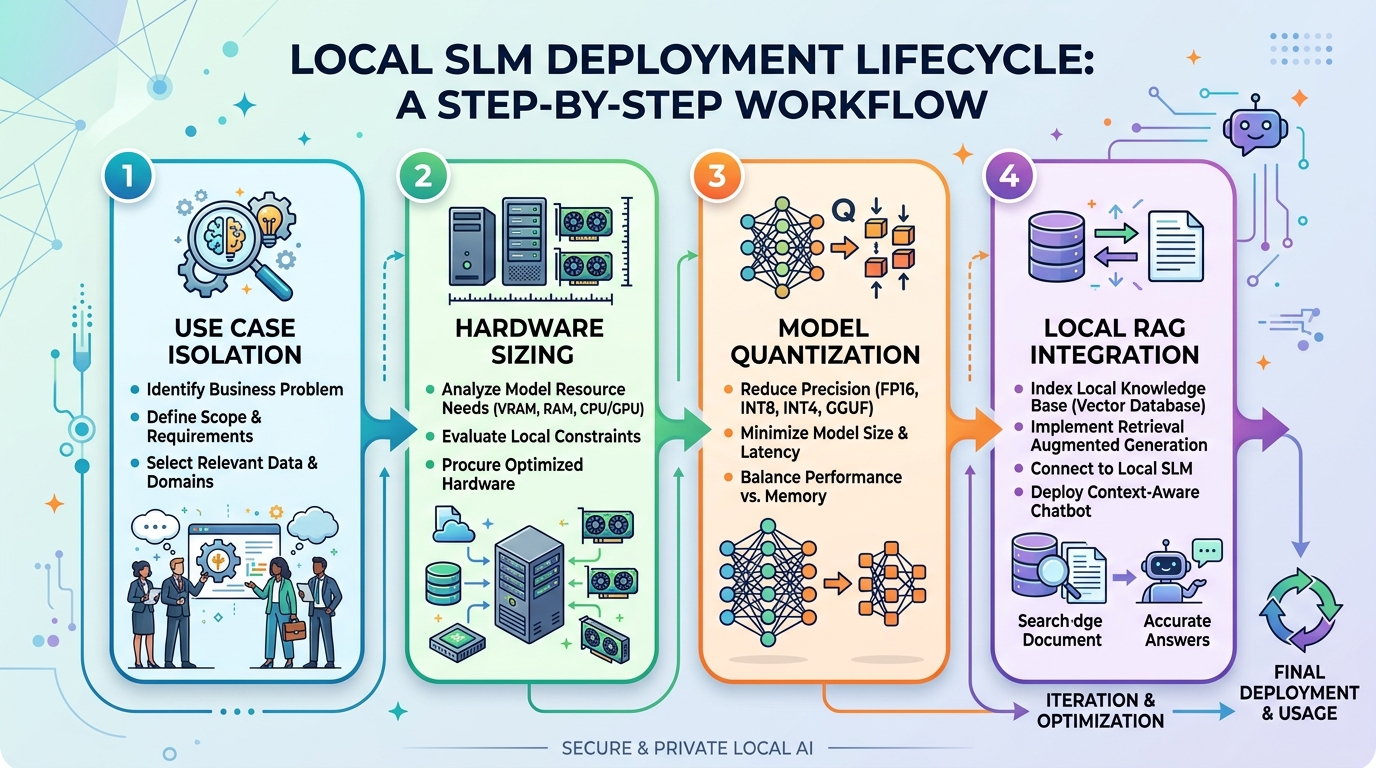
Successfully implementing local small language models requires a structured, deliberate approach. Below is a deployment roadmap designed to help your technical team move from evaluation to local production.
Step 1: Identify and Isolate Specific Use Cases
Do not try to build a local assistant that can answer general knowledge questions. Instead, identify high-volume, narrow tasks where your team currently uses manual effort or expensive APIs. Ideal candidates include:
- Structured data extraction (converting unformatted emails or PDFs into clean JSON schemas).
- Automated ticket triaging and customer support classification.
- Internal document search, comparison, and policy analysis.
Step 2: Determine Your Hardware Requirements
One of the greatest benefits of SLMs is their modest hardware footprint. You do not need massive server farms. A standard workstation equipped with a single modern enterprise GPU can comfortably run multiple 8B parameter models simultaneously. If you prefer cloud infrastructure, you can deploy these models on highly cost-effective, single-GPU virtual private servers (such as AWS, Azure, or specialized GPU clouds) within your existing virtual private cloud (VPC).
Step 3: Apply Model Quantization and Optimization
Before running a model locally, optimize it using quantization. Quantization reduces the numerical precision of the model's weights (for example, converting 16-bit floating-point numbers down to 4-bit or 8-bit integers). This process dramatically reduces the RAM and GPU memory required to run the model, often by 70% or more, with almost zero noticeable loss in output quality. Popular runtime frameworks like llama.cpp, vLLM, or Ollama make loading quantized models seamless.
Step 4: Pair with Local Retrieval-Augmented Generation (RAG)
An SLM on its own does not know your company's internal history or specific customer records. To provide the model with context, pair your local SLM with a local vector database. When a user asks a question, your system performs a fast local vector search to retrieve relevant context from your internal documents, embeds that context into the prompt, and feeds it to the SLM. This creates a fully closed, private, and hyper-accurate knowledge assistant.
Conclusion: Reclaiming Your Enterprise AI Architecture
The future of enterprise AI is not centralized in a handful of giant, external cloud brains. It is distributed, specialized, and hyper-local. By integrating local small language models into your operations, you gain complete control over your data security, eliminate unpredictable operational costs, and build a highly responsive, custom-tailored AI capability that operates completely inside your corporate boundary.
Start small: identify a single, high-frequency text-processing workflow in your team, download a highly rated open-source SLM, run it locally on a workstation, and measure the immediate gains in privacy, speed, and cost efficiency. The tools are ready, the models are open, and the competitive advantage goes to those who build on their own terms.
Related Reading
To learn more about optimizing your internal AI infrastructure, protecting your data, and structuring your agentic workflows, explore our deep-dives below:
Enjoyed this article? Join the Growency newsletter
Practical AI tips for service businesses, straight to your inbox. No spam, unsubscribe anytime.