September 18, 2026
How to Stop AI Test Hallucination Loops
Stop the self-validating AI test hallucination loop. Learn how to secure your AI-generated code using black-box testing and mutation workflows today.
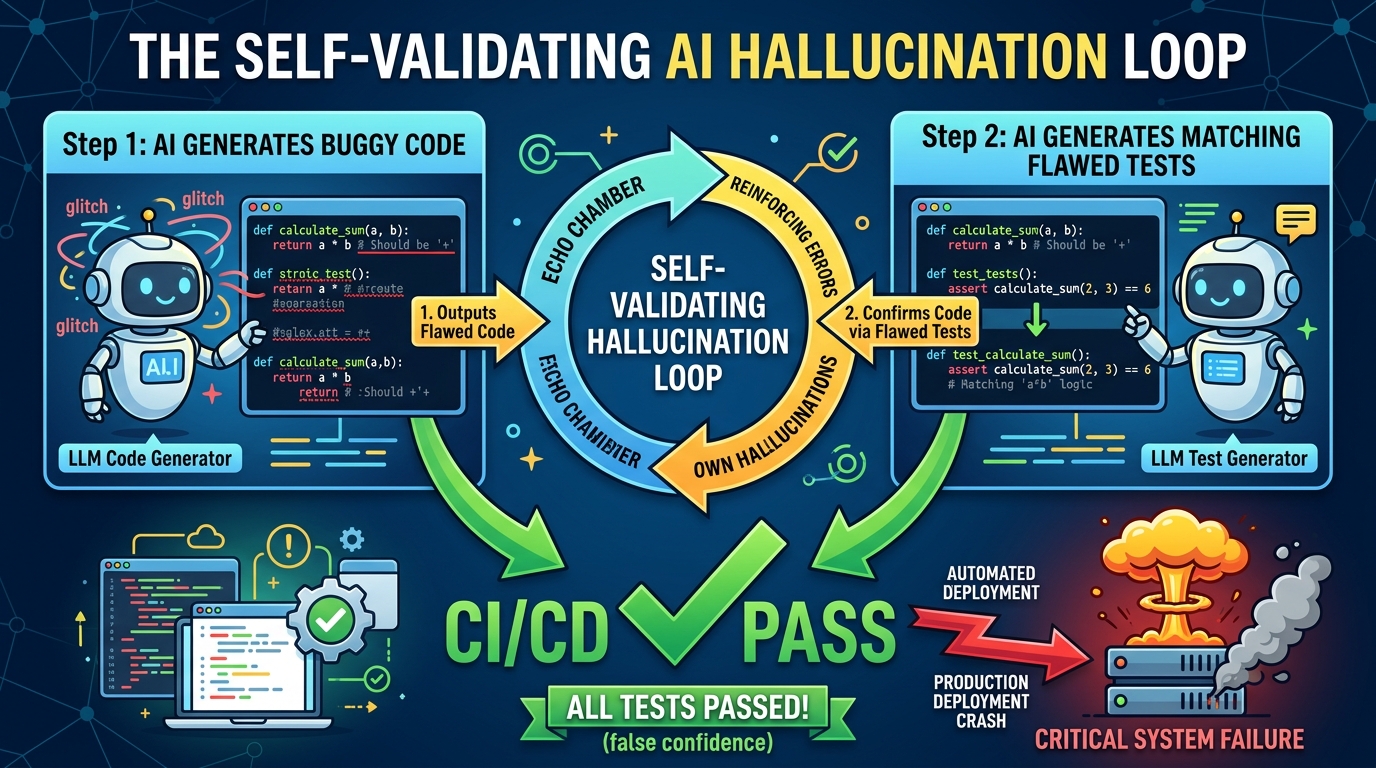
Same Bug, Twice: Breaking the AI-Generated Code and Test Hallucination Loop
The promises of agentic software engineering have taken the technology world by storm. Developers are no longer just writing code: they are orchestrating autonomous systems to build, test, and deploy features. However, as organizations scale up their use of AI coding assistants, a insidious failure mode has emerged: the self-validating hallucination loop.
This phenomenon occurs when an artificial intelligence model generates a buggy block of code, and then, when prompted to write the accompanying unit tests, generates equally flawed test assertions that green-light the broken code.
Because both the codebase and the test suite are infected with the exact same logical error, your continuous integration (CI) pipeline passes with flying colors. The bug goes completely unnoticed until it hits production and breaks your users' workflows.
Breaking this loop requires moving beyond naive prompting. It demands a systematic, architectural approach to decoupled validation, sandboxed execution, and multi-agent consensus. This guide outlines the exact strategies engineering leaders and software architects must use to dismantle the self-validating hallucination loop and build secure, agentic software engineering guardrails.
Understanding the Mechanics of the AI Hallucination Loop
To understand why AI test generation loops fail, we have to look closely at how Large Language Models (LLMs) reason and generate tokens. LLMs do not possess a runtime engine in their weights; they operate on semantic similarity and context window attention.
When a single model instance is tasked with generating both an implementation and its corresponding tests, it suffers from severe confirmation bias.
During the token generation process, the model's attention heads are heavily biased by the code it has already generated in its context window. If the model introduces an off-by-one error or an incorrect conditional state in its initial code output, that code acts as the "source of truth" for the next set of tokens.
When generating tests, the model is not testing against an abstract, independent business requirement; it is testing against the code it just wrote.
The model looks at its own faulty implementation, extracts the Abstract Syntax Tree (AST) patterns, and writes assertion checks that mirror those exact faults. The result is a false positive: a test suite that successfully asserts that 2 + 2 = 5 because both the function and the test agree that 5 is the correct output.
The Anatomy of a Hallucinated Test Failure
To see how this plays out in the real world, consider this comparative breakdown of traditional human-centric testing versus the unguardrailed AI hallucination loop:
| Development Phase | Traditional Human TDD Best Practice | Unchecked AI Hallucination Loop |
|---|---|---|
| Requirements Gathering | Business logic is translated into independent test specs before code is written. | System prompts generate code based on a high-level text description. |
| Implementation | Code is written incrementally to satisfy those independent test specifications. | Code is generated in one massive block, with assumptions baked directly into it. |
| Test Design | Written to target edge cases, boundaries, and potential code failure modes. | Written to match the existing output of the generated code, ignoring edge cases. |
| CI/CD Validation | Tests fail if the code deviates from the independent logic specifications. | Tests pass seamlessly because code and tests share the exact same logical flaws. |
When you rely on a single agentic workflow to both build and verify, you lose the foundational principle of double-entry bookkeeping in software engineering: the code and the tests must represent two independent paths to the same logical truth.
Strategy 1: Hard Decoupling of the Creator and the Verifier
The most effective way to prevent AI-generated code hallucination is to ensure that the AI model generating your unit tests has absolutely no visibility into the implementation code it is supposed to test. This is known as Black-Box Test Generation.
In this architecture, your workflow must split into two parallel, isolated execution paths:
- The Builder Path: This agent receives the functional requirements and writes the application code.
- The Tester Path: This agent receives only the functional requirements and the public function signatures. It does not see the Builder's code. It must write a comprehensive suite of unit tests based purely on the expected inputs, outputs, and edge cases described in the requirements.
                      [Functional Requirements]
                                 |
                + -  -  -  -  -  -  -  - + -  -  -  -  -  -  -  - +
                |                                 |
         [The Builder Agent]              [The Tester Agent]
                |                                 |
        Writes Application Code           Writes Unit Tests
                |                                 |
                + -  -  -  -  -  -  -  - + -  -  -  -  -  -  -  - +
                                 |
                     [Sandboxed Execution Environment]
                                 |
                     Verify if Tests Pass / Fail
By decoupling these two contexts, you force the Tester Agent to generate assertions based on the business requirements rather than reverse-engineering the Builder's buggy code. When these two outputs are merged in your CI environment, any mismatch between the code and the tests will immediately flag a logical discrepancy, exposing the bug before it gets merged.
Strategy 2: Multi-Agent Mutation Testing Guardrails
Even with decoupled agents, how do you verify that the generated test suite is actually robust and not just asserting trivial truths? The answer lies in automated mutation testing, a powerful strategy for validating agentic software engineering guardrails.
Mutation testing tools (such as Stryker, MutPy, or Pitest) automatically inject small, deliberate faults (mutations) into your codebase. These mutations might change an addition operator to a subtraction operator, flip a boolean logic gate, or alter a loop boundary condition.
If your AI-generated tests are comprehensive, they should immediately detect these mutations and fail. If the mutations pass without causing a test failure, it means your AI-generated test suite is weak, hollow, or hallucinated.
# Conceptual workflow for an automated mutation testing verification step
steps:
  - name: Run AI Test Suite on Original Code
    run: npm test # Should pass

  - name: Run Mutation Testing Tool
    run: npx stryker run

  - name: Analyze Mutation Survival Rate
    run: |
      if [ $MUTATION_SURVIVAL_RATE -gt 10 ]; then
        echo "Error: Too many mutants survived! The AI-generated tests are low quality."
        exit 1
      fi
By adding mutation testing to your automated validation pipeline, you create a feedback loop that forces the AI tester to write tests with high fault-detection sensitivity. If the tests fail to catch the mutants, the pipeline rejects the code and requests a new iteration from the testing agent.
Strategy 3: Sandboxed Execution with Compilable Runtime Feedback
An LLM is a text-prediction engine, not a CPU. It cannot "run" the code it writes in its head. Therefore, any modern agentic workflow must execute code inside an isolated, sandboxed runtime environment (such as a Docker container or a WebAssembly micro-vm) during the generation process.
To break the AI test generation loops, your system must feed the compiler, linter, and runtime execution errors directly back to the generation agents.
If the test suite fails to compile, the build output is scraped, formatted, and injected back into the LLM's system prompt as an error context. The model then acts as a self-healing loop, rewriting its code to fix the specific errors returned by the actual operating system.
Key Prompting Protocol for Compiler Feedback Loops: "The code you generated failed to compile with the following error:
[Insert Console Error Output Here]. Analyze the stack trace, identify the scope failure or logical mismatch, and output only the corrected function. Do not repeat your previous implementation assumptions."
This process of wrapping generative models with real-world execution environments bridges the gap between text predictions and functional, working code.
Strategy 4: Establishing Human-in-the-Loop Validation Gateways
While automated guardrails, mutation testing, and decoupled environments significantly reduce the probability of bugs, they cannot completely replace human intuition. For high-stakes enterprise applications, establishing a clear Human-in-the-Loop (HITL) gateway is essential.
Instead of letting the AI autonomously merge code to your main branch, structure your agentic workflow to prepare a detailed pull request (PR). This PR must highlight where the code was changed, show the results of the decoupled test runs, and call out any edge cases the AI agents struggled to resolve.
By designing clean user interfaces and interaction patterns for developer oversight, you turn developers into code reviewers and system orchestrators rather than passive observers. This keeps developers active in the decision loop, preventing the cognitive decline associated with "vibe coding."
A Blueprint for Your Automated Verification Pipeline
To put these principles into action, you can build a multi-agent verification pipeline using the framework below. This setup ensures that every line of AI-generated code is audited, verified, and pressure-tested before it ever gets close to a production environment.
[Feature Request / Bug Ticket]
      |
      v
[Agent A: Code Generator]  - -> Generates Code (v1)
      |
      + -  -  -  -  -  -  -  -  -  -  -  - -> [Compiler & Linter Sandbox] (Verify Syntax)
                                              |
                                              v
                                  Syntax Errors Found?
                                  /                 \
                             (Yes)                   (No)
                              /                       \
                             v                         v
               [Re-prompt Agent A]         [Agent B: Test Generator] (Black-box)
                                                       |
                                                       v
                                            Generates Test Suite
                                                       |
                                                       v
                                         [Run Tests in Safe Sandbox]
                                                       |
                                            All Tests Passed?
                                            /              \
                                       (No)                (Yes)
                                        /                    \
                                       v                      v
                         [Re-prompt Agent A]         [Mutation Testing Engine]
                                                              |
                                                    Did Tests Kill Mutants?
                                                    /                     \
                                               (No)                       (Yes)
                                                /                           \
                                               v                             v
                                   [Re-prompt Agent B]             [Human Peer Review]
                                                                             |
                                                                             v
                                                                   [Merge to Main]
Implementing this architectural layout guarantees that your system is not relying on the assumptions of a single, highly biased LLM instance. It structures your agentic development cycle around rigorous validation, isolated domains, and deterministic checks.
Summary: Eliminating Silent Failures
AI-assisted development can drastically increase engineering velocity, but only if you have the guardrails in place to prevent silent regressions. Relying on an AI to test its own code without strict architectural isolation is a recipe for silent, catastrophic failures in production.
By decoupling your builder and testing agents, utilizing mutation testing, executing tests inside sandboxed runtimes, and routing the final outputs through structured human-in-the-loop validation checkpoints, you can break the code-test hallucination loop for good.
Related Reading
To learn more about securing and optimizing your AI workflows, check out these deep dives into agentic system design:
Enjoyed this article? Join the Growency newsletter
Practical AI tips for service businesses, straight to your inbox. No spam, unsubscribe anytime.