August 24, 2026
How to Build a Human in the Loop AI Workflow
Learn how to build a bulletproof ai quality control system. Use our human in the loop ai blueprint to protect your brand and optimize your content pipeline.
The Human in the Loop Blueprint: How to Architect a Bulletproof Quality Control System for AI Outputs
Artificial intelligence has transitioned from a novel experiment to the operational core of modern tech and digital brands. Companies are using generative AI to produce content, write code, analyze data, and build customer service pipelines at a scale that was unimaginable a decade ago.
However, this rapid scaling has exposed a critical vulnerability: the reliability gap. Generative models are probabilistic, not deterministic. They are designed to predict the most statistically plausible next word or pixel, not necessarily the most accurate or brand-aligned one. Without systematic human intervention, relying entirely on raw AI generation is a fast track to brand dilution, legal liability, and costly operational errors.
To capture the efficiency of automation while maintaining absolute brand integrity, organizations must adopt a rigorous human in the loop AI methodology. This blueprint provides a step-by-step master guide to designing, deploying, and scaling an AI quality control framework that protects your brand and supercharges your team's productivity.
The Core Philosophy: Why Raw AI Output is a Business Liability
The allure of zero-marginal-cost generation has led many teams to implement "set-and-forget" AI pipelines. But treating artificial intelligence as a fully autonomous agent is a fundamental misunderstanding of the technology. Large Language Models (LLMs) do not possess situational awareness, empathy, or a true understanding of your business goals.
When left unchecked, automated workflows face three primary risks:
- Hallucination and Factuality Decay: Models will confidently fabricate statistics, legal precedents, and product features to satisfy a prompt's structural constraints.
- Homogenization of Voice: Out-of-the-box model outputs tend to sound remarkably similar. Without human editorial control, your brand's unique point of view is replaced by generic, beige prose.
- Contextual Blindness: AI models lack real-time market empathy. They cannot understand current cultural sensitivities, subtle competitive dynamics, or highly specific customer journey nuances.
|
                                                (Human-in-the-Loop Intervention)
                                                            |
                                                            v
                                            [Verified, Brand-Aligned Output]
Implementing a robust AI quality control framework is not about slowing down your workflows. Instead, it is about shifting your team's role from raw creation to high-level orchestration, curation, and validation. This shift ensures you maintain absolute control over accuracy, style, and security.
The Four Pillars of an AI Quality Control Framework
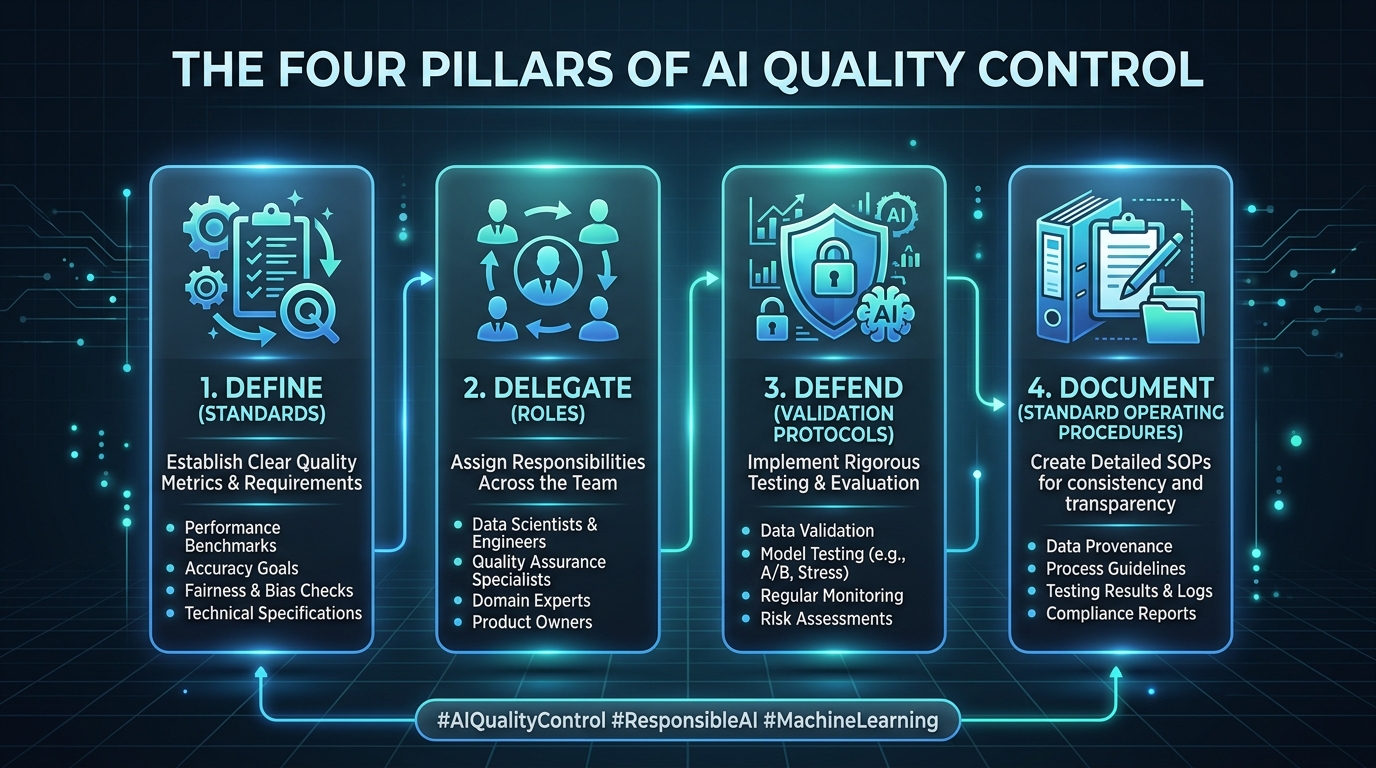
To build an operational guardrail around generative models, you need a systematic approach. A complete quality control blueprint is built on four core pillars: Define, Delegate, Defend, and Document.
1. Define: Establish Your Brand's Algorithmic Constitution
Before a human reviews a single word of AI-generated content, you must define the exact standards the AI must meet. This is your "Algorithmic Constitution." It consists of three parts:
- Tone Boundaries: Clear, non-negotiable guidelines on style, perspective, and phrasing. (e.g., "We are authoritative but accessible. We never use hype-words like 'revolutionizing' or 'groundbreaking'.")
- Factuality Standards: Rules outlining what requires external verification. Any stat, quote, or historical claim must be cross-referenced with a trusted source.
- Compliance Checklists: Technical guidelines covering data privacy, copyrighted material, and ethical use of intellectual property.
2. Delegate: Assigning Clear Editorial Roles
Quality control fails when everyone is responsible, because then no one is. You must assign distinct human roles to oversee different parts of your AI editorial workflow:
- The Prompt Architect: Responsible for building, testing, and refining the system prompts and custom instructions that guide the AI.
- The Domain Expert: A human-in-the-loop specialist with deep industry knowledge who evaluates the outputs for conceptual depth and practical accuracy.
- The Line Editor: A language specialist who refines the rhythm, eliminates repetitive AI patterns, and ensures the output matches the brand's unique voice.
3. Defend: Establishing Multi-Gate Validation Protocols
Do not rely on a single, brief review before publishing or deploying AI outputs. Implement a multi-gate system where content must pass through successive levels of human validation depending on its risk profile. Low-risk content (like internal summaries) may require only a single quick check, whereas high-risk content (such as customer-facing advice or technical documentation) must clear rigorous factual and legal gates.
4. Document: Continuous Loop Feedback
Your quality control system should be a closed loop. Every time a human editor corrects a systematic AI error (such as a recurring hallucination or a stylistic tic), that feedback must be documented and used to update the prompt templates or fine-tuning datasets. This continuous iteration ensures that your AI tools become smarter and more aligned with your specific workflows over time.
Tactical Execution: Setting Up Your AI Editorial Workflow
Moving from theory to practice requires embedding human verification directly into your production lines. Below is an operational matrix that outlines how to divide labor between AI generation and human oversight across a standard content pipeline.
| Workflow Phase | AI Responsibility | Human-in-the-Loop Responsibility |
|---|---|---|
| Research & Outlining | Clustering keywords, summarizing long-form source documents, and drafting preliminary structure. | Verifying source document credibility, adjusting structural flow, and adding original proprietary insights. |
| First Draft Generation | Generating initial sections based on detailed, context-rich prompts and outlines. | Auditing for structural coherence and identifying gaps where the AI generalized instead of providing specifics. |
| Fact-Checking | N/A (AI should not be trusted to verify its own facts). | Explicitly verifying every statistic, external link, quote, and technical claim against trusted primary sources. |
| Stylistic Editing | Rewriting specific sentences for clarity or adjusting length constraints. | Eliminating robotic transitions, inject brand-specific anecdotes, and adjusting the emotional resonance of the piece. |
| Final Compliance Gate | Running basic grammar checks and scanning for accidental duplicate text. | Checking against intellectual property guidelines, verifying data privacy, and giving final sign-off. |
Key Insight: The goal of this matrix is to maximize human leverage. By offloading the initial structuring and drafting to AI, humans can spend 100% of their energy on deep editing, fact-checking, and strategic refinement - the high-value tasks that truly elevate the end product.
Mitigating AI Hallucinations through Strategic Prompting
While human review is your final line of defense, you can dramatically reduce errors upstream by using advanced prompting techniques designed for mitigating AI hallucinations. The more structured and constrained your initial prompt, the more reliable the output will be.
Here is a reusable system-level prompt template designed to force the AI to self-assess and flag its own uncertainties before presenting them to your human team:
You are an expert technical researcher operating under strict accuracy constraints.
Your objective is to draft a comprehensive breakdown of [Topic].

Follow these execution guidelines:
1. Grounding: Rely ONLY on the verified context provided in the input blocks. Do not assume, extrapolate, or introduce outside historical data unless it is universally acknowledged as a public fact.
2. Citation: For every technical claim, statistic, or direct quote, insert a placeholder citation indicating where the source material supports this statement.
3. Uncertainty Identification: If you are asked to explain a concept or provide data that is not present in your training data or the provided context, do not attempt to guess. Instead, write "[HEURISTIC WARNING: VERIFICATION REQUIRED]" followed by a brief description of what information is missing.

Before outputting your response, run a mental self-correction pass. Check if any statement sounds overly confident yet lacks explicit source backing.
By forcing the model to explicitly flag its own analytical gaps, your human editors can immediately focus their attention on the exact areas of the document that carry the highest risk of inaccuracies.
Scaling the Blueprint Without Creating Bottlenecks
The most common objection to implementing a human-in-the-loop workflow is that it slows down the production engine. If your team has to manually check every single word, do you actually save any time?
The answer lies in strategic tiering. Not all AI outputs are created equal. To scale successfully, you must categorize your outputs by risk and apply appropriate validation gates:
              [AI Output Risk Level]
                     |
         + -  -  -  -  - -+ -  -  -  -  - -+
         |                       |
     [Low Risk]             [High Risk]
  (Internal/Admin)       (Public/Technical)
         |                       |
   [Single Pass]          [Multi-Gate Review]
 (Quick human review)    (Fact-check, Edit, Sign-off)
- Tier 1: Low Risk (Internal Use): This includes meeting summaries, brainstorming drafts, and rough internal translations. For these, a simple single-pass review by the end user is sufficient.
- Tier 2: Medium Risk (Standard Marketing & Ops): Social media posts, educational blog content, and automated email sequences. This requires a standard editorial pass focusing on brand voice alignment and basic factual verification.
- Tier 3: High Risk (Legal, Technical, & Financial): Customer-facing support advice, API documentation, contract analysis, and medical or financial guides. This tier demands rigorous, multi-gate validation involving domain experts and formal sign-offs.
By reserving your heavy editorial resources for high-risk assets, you maintain organizational agility while completely protecting your brand's reputation and compliance standing.
Related Reading
To learn more about optimizing your team's systems and integrating artificial intelligence into your content operations, explore these comprehensive guides:
Enjoyed this article? Join the Growency newsletter
Practical AI tips for service businesses, straight to your inbox. No spam, unsubscribe anytime.