September 4, 2026
Generative AI Cost Calculation Guide
The Enterprise AI ROI Framework: How to Calculate the True Cost and Value of Generative AI The generative artificial intelligence hype cycle is transitioning in
The Enterprise AI ROI Framework: How to Calculate the True Cost and Value of Generative AI
The generative artificial intelligence hype cycle is transitioning into a period of strict fiscal scrutiny. Boardrooms and CFOs, who once enthusiastically approved pilot budgets, are now demanding concrete proof of value. The core challenge is that traditional IT financial models fail when applied to generative systems.
Token fluctuations, context window economics, inference latency, prompt engineering iterations, and model drift introduce highly volatile cost structures. To scale artificial intelligence across the organization, enterprise leaders must pivot from speculative pilots to a rigorous enterprise ai roi framework. This playbook outlines a practical, mathematical methodology to calculate the true total cost of ownership of generative AI while accurately tracking both tangible and intangible business value.
Deconstructing the Total Cost of Ownership (TCO) of Generative AI
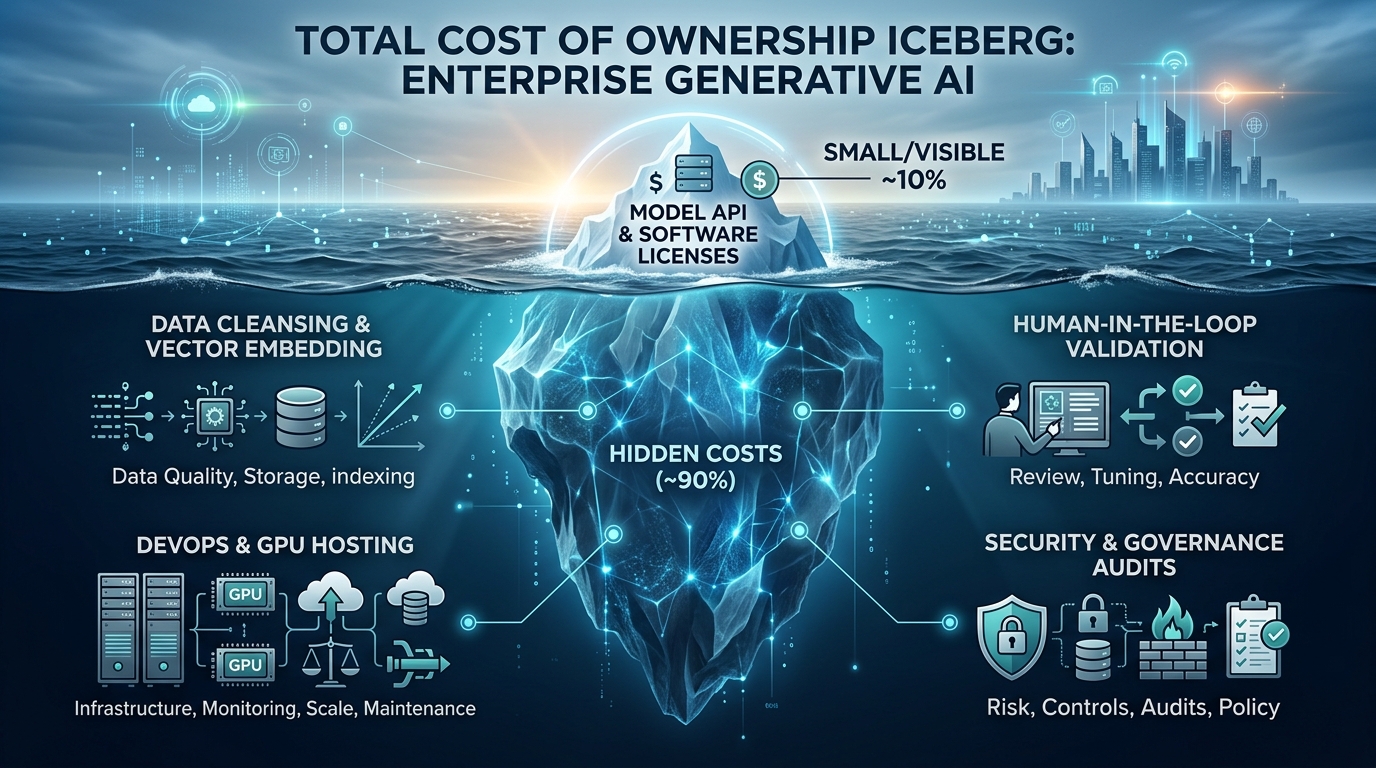
To calculate your return on investment, you must first master the cost side of the ledger. Most enterprise leaders mistake their monthly LLM API invoice or software SaaS fee for their total system cost. In reality, license fees represent just a fraction of the actual expense.
A realistic generative ai cost calculation must account for three core layers of expenditure:
1. Infrastructure and Development Costs
These are the upfront investments required to take an enterprise AI system from concept to production. This includes:
- Data Preparation and Pipelines: Cleaning, structuring, and embedding enterprise data for Retrieval-Augmented Generation (RAG) systems.
- Engineering Labor: The hours spent by data scientists, software developers, and cloud architects building and optimizing prompts, APIs, and middleware.
- Customization Efforts: The cost of building custom system prompts, vector databases, or performing targeted model fine-tuning.
2. Operational Run-Rate Costs
These are the ongoing, recurring costs to keep your generative AI application functional in production. They include:
- API Token Consumptions: The variable charges from proprietary model providers based on input and output prompt volume.
- Dedicated Hosting and GPU Compute: The fixed cloud costs required to host open-source models on dedicated server instances.
- Database Read/Write Fees: The continuous querying costs of vector search databases and knowledge graphs.
3. Management and Compliance Costs
Often overlooked, these expenses safeguard your enterprise from legal, operational, and brand risks:
- Human in the Loop Quality Control: The cost of human specialists reviewing AI outputs to prevent brand damage or operational mistakes.
- Continuous Security Audits: Regular testing of models for prompt injections, data leakage, and compliance with data privacy regulations.
- Governance and Monitoring Tools: Software licenses for observability platforms that track latency, accuracy, and system drift.
To visualize how these costs vary depending on your choice of infrastructure, look at this high-level comparison matrix:
| Cost Component | Proprietary SaaS APIs (e.g., GPT-4) | Custom Open-Source LLMs (Self-Hosted) |
|---|---|---|
| Setup & Implementation | Low setup complexity, minimal specialized staff | High initial setup, demands experienced DevOps |
| Scalability Cost | Variable and linear: scales with token usage | Fixed step-costs: scales with GPU server blocks |
| Data Prep & RAG | Medium investment: clean data mapped to APIs | High investment: local vector database construction |
| Compliance Auditing | Dependency on vendor security frameworks | Absolute operational control, lower long-term risk |
Measuring Generative AI Value: Hard ROI vs. Soft ROI
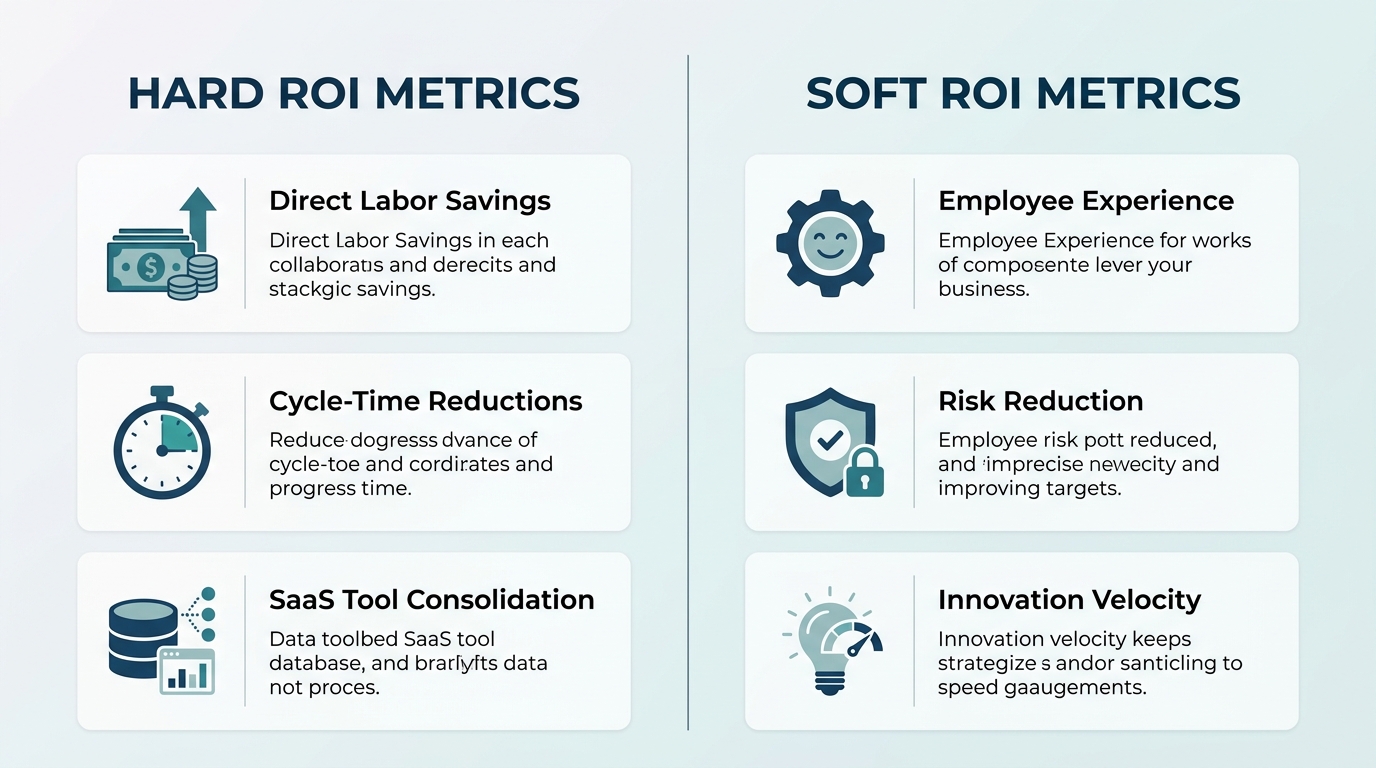
On the other side of the ledger is value creation. Measuring generative ai value requires a dual approach: tracking Hard ROI (direct, easily quantifiable financial savings or revenue gains) and Soft ROI (strategic, qualitative improvements that influence long-term business performance).
Calculating Hard ROI
Hard ROI is mathematically objective. It is expressed as a direct reduction in operational expenditure or an increase in top-line revenue:
- FTE Labor Reallocation: The absolute number of hours saved by automating manual, repetitive knowledge-work workflows. Note that this value is only captured if those saved hours are successfully reallocated to higher-value, revenue-generating tasks.
- Legacy Tool Consolidation: Cost savings achieved by deprecating redundant software-as-a-service (SaaS) subscriptions that the generative AI application replaces.
- Cycle-Time Reduction: The financial value of executing projects faster: such as accelerating software deployment cycles, reducing time-to-market for marketing campaigns, or resolving customer support tickets on the first interaction.
Key Insight: To turn saved time into hard savings, organizations must have a clear "Capacity Reallocation Plan". If an AI tool saves 10 hours a week for 50 employees, but those 500 hours are absorbed by administrative drag, your actual ROI is zero.
The direct formula for calculating Hard ROI is:
$$Hard\ ROI\ (%) = \frac{(Direct\ Savings + New\ Revenue)\ -\ Total\ Cost\ of\ Ownership}{Total\ Cost\ of\ Ownership} \times 100$$
Calculating Soft ROI
Soft ROI consists of benefits that are highly valuable but harder to isolate on a financial statement:
- Employee Retention and Satisfaction: Eliminating tedious, repetitive workflows reduces employee burnout and improves retention rates.
- Enhanced Customer Experience (CX): Lowering customer wait times and providing more accurate, personalized support interactions, leading to higher Net Promoter Scores (NPS).
- Innovation Velocity: Enabling teams to run more rapid micro-experiments: such as drafting several content strategies or code prototypes in parallel.
The Step-by-Step Enterprise AI ROI Calculation Process
To implement a repeatable enterprise ai roi framework, your organization should follow this five-step operational methodology.
Step 1: Establish the Performance Baseline
Before deploying any generative tool, measure the current state of the workflow you intend to optimize. Document the exact steps, the tools used, the time required, the average error rate, and the hourly cost of the human workers currently executing the tasks.
Step 2: Calculate Your Production TCO
Compile your upfront development, cloud setup, and integration costs. Amortize these capital expenditures over a realistic time horizon (typically 12 to 24 months). To this figure, add your monthly recurring operational costs (APIs, compute hosting, maintenance labor, and human verification).
Step 3: Quantify the Efficiency Gains
Measure the performance of the workflow after the AI system is integrated. Track the speed of task completion, the accuracy of the outputs, and the overall volume of tasks handled without human intervention.
For example, if your baseline content creation process took 6 hours of human work ($300 at a fully loaded labor rate of $50 per hour) and the AI system reduces that to 1 hour of human drafting plus 30 minutes of human review, you have saved 4.5 hours ($225 in value) per document.
Step 4: Account for Errors, Reviews, and Risk
No model is perfect. Your ROI calculation must subtract the cost of correcting AI errors, reviewing hallucinations, and managing edge cases. If 5% of the generated outputs require comprehensive manual rewriting, factor that cost back into your TCO.
Step 5: Adjust for Scalability and Run the Calculation
Combine your findings into a final financial report. Compare the total amortized cost of building and running the system against the monthly value created.
To see how this works in practice, examine this sample evaluation scorecard for a standard Retrieval-Augmented Generation (RAG) system deployed to assist a customer support team:
| Evaluation Dimension | Baseline Performance | Post-AI Integration Target | Total Financial Impact |
|---|---|---|---|
| Average Resolution Time | 40 minutes per ticket | 12 minutes per ticket | $28.00 saved per support ticket |
| Escalation Rate | 25% of tickets escalated | 8% of tickets escalated | $45.00 saved per avoided tier-2 ticket |
| Employee Training Time | 15 business days | 5 business days | $2,500 saved in onboarding labor per hire |
| Content Review Overhead | 0 minutes | 4 minutes per draft | $3.33 cost added per ticket for human review |
Operational Strategies to Maximize Your Generative AI ROI
If your initial ROI calculations fall short of expectations, it is usually because the cost of infrastructure or model APIs outpaces the value of the time saved. To correct this imbalance, enterprise leaders can use several proven architectural strategies:
- Leverage Small Language Models (SLMs): Not every enterprise application requires a massive, multi-billion-parameter foundation model. By deploying highly specialized, open-source small language models locally or in a private cloud, you can slash hosting fees, reduce latency, and ensure absolute data privacy.
- Optimize Your Customization Strategy: Building an effective AI system does not always mean expensive fine-tuning. Often, a well-architected RAG pipeline yields higher accuracy and lower implementation costs than attempting to fine-tune a model from scratch.
- Prevent AI Sprawl: Run regular audits to consolidate redundant AI tools and APIs across your departments. Left unmonitored, departments will purchase overlapping software licenses, creating security vulnerabilities and fragmenting your budget.
By applying this structured framework, your business can confidently identify, build, and scale high-impact generative AI applications that deliver verifiable, long-term economic value.
Related Reading
Enjoyed this article? Join the Growency newsletter
Practical AI tips for service businesses, straight to your inbox. No spam, unsubscribe anytime.