September 9, 2026
From Vibe Coding to Production: Guardrailing Agentic Workflows Against Architectural Decay
From Vibe Coding to Production: Guardrailing Agentic Workflows Against Architectural Decay The tech industry is currently experiencing a historic paradigm shift. With the rise of advanced reasoning models, developers and businesses are building complex systems through "vibe codin...
From Vibe Coding to Production: Guardrailing Agentic Workflows Against Architectural Decay
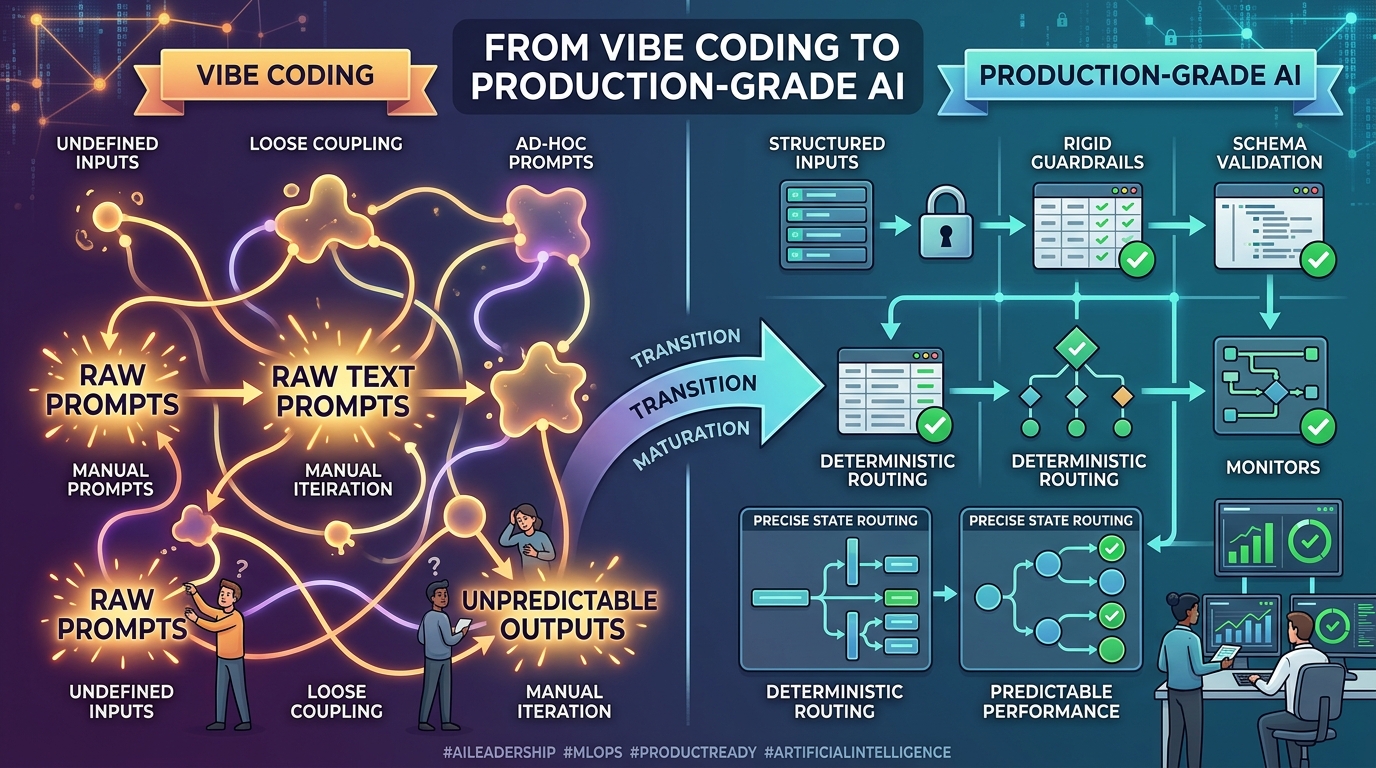
The tech industry is currently experiencing a historic paradigm shift. With the rise of advanced reasoning models, developers and businesses are building complex systems through "vibe coding" - the fast, iterative process of generating software purely through conversational prompting. It is an exhilarating phase where proof-of-concepts are built in minutes instead of months.
However, when these prototype systems are pushed into mission-critical environments, the vibes quickly run out.
Without rigid boundaries, autonomous agentic workflows are prone to architectural decay. This decay manifests as cascading failures, state corruption, unbounded execution loops, and API cost explosions. Moving from an exciting demo to a resilient, production-ready system requires shifting from passive observation to active, structured orchestration.
This comprehensive guide explores the structural, semantic, and operational guardrails necessary to transition your AI agents from chaotic vibe coding to predictable, enterprise-grade execution.
Understanding Architectural Decay in Agentic Workflows
Architectural decay in traditional software design is a slow, creeping disease. In agentic workflows, however, it can occur in a matter of seconds. Because large language models (LLMs) operate probabilistically, minor changes in an API response, prompt structure, or user input can cause an agent's behavior to drift radically from its intended path.
There are three primary vectors where vibe-coded agents break down under production pressure:
- Semantic Drift: The agent slowly loses context over a long-running execution thread, leading to hallucinations, goal-abandonment, or repetitive processing loops.
- State Fragmentation: Multi-agent systems fail to synchronize their understanding of the system's current state, causing conflicting decisions or data corruption.
- Tool Misuse: Agents pass malformed payloads to external APIs, call tools in incorrect sequences, or trigger infinite loops of self-correction when an API returns an error.
To understand how these systems decay, we can compare the chaotic paradigm of vibe coding with the highly structured nature of production-grade agentic architectures.
| Architectural Dimension | Vibe Coding Paradigm | Production-Grade Paradigm |
|---|---|---|
| State Management | Ephemeral, in-memory context windows | Externalized, version-controlled state stores |
| Output Validation | Optimistic parsing (hoping JSON is valid) | Strict schema validation with Pydantic / Zod |
| Tool Execution | Direct, unmonitored API calls | Gateway-brokered, rate-limited tool invocation |
| Error Handling | LLM-driven retry loops (costly and infinite) | Deterministic fallback paths and circuit breakers |
| Evaluation Strategy | "Looks good to me" manual inspection | Automated evaluation datasets and LLM-as-a-judge |
The Guardrail Framework: Three Pillars of Robust AI Orchestration
To prevent architectural decay in agentic workflows, software architects must implement a multi-layered guardrail framework. These guardrails act as physical barriers, keeping the probabilistic nature of LLMs safely funneled within deterministic software tracks.
1. Structural Guardrails (Schema & Type Enforcement)
The first line of defense against architectural decay is strict schema enforcement. You should never allow an agent to return raw, unstructured text when a structured format is expected.
By leveraging native tool-calling features and JSON schemas, you can force the model's attention mechanism to align with strict data structures. Tools like Pydantic in Python or Zod in TypeScript allow you to define the exact shape of your agent's inputs and outputs.
For example, if an agent is designed to route customer support tickets, do not let it output a freeform text explanation. Force it to conform to a strict, typed schema:
from pydantic import BaseModel, Field
from typing import Literal

class TicketRoutingDecision(BaseModel):
    category: Literal["billing", "technical_support", "sales", "general"]
    confidence_score: float = Field(..., ge=0.0, le=1.0)
    priority: Literal["low", "medium", "high", "critical"]
    suggested_action: str = Field(..., min_length=10)
By enforcing this structure, you create a deterministic boundary. If the LLM generates a response that violates this schema, your execution engine catches the validation error before it downstreams to other services, allowing you to trigger structured repair prompts or clean fallbacks.
2. Semantic Guardrails (Output Context Validation)
While structural guardrails handle the syntax, semantic guardrails evaluate the meaning, alignment, and safety of the agent's output. You must ensure the agent does not invent facts, breach compliance boundaries, or leak sensitive system instructions.
Implementing semantic guardrails requires placing runtime evaluation checks immediately after the LLM generates an output but before that output is exposed to users or tools. Popular open-source frameworks like Guardrails AI or NeMo Guardrails allow developers to run assertions on the generated content, such as:
- Factual Consistency: Running natural language inference (NLI) models to verify that the generated summary is fully supported by the source documents (preventing hallucinations).
- PII Redaction: Scanning outputs for Social Security numbers, credit card details, or API keys.
- Toxicity and Jailbreak Detection: Ensuring the agent has not been manipulated by a user prompt-injection attack.
3. Operational Guardrails (State, Telemetry, and Budgets)
Even the smartest agent can get stuck in an expensive, infinite execution loop. For instance, if an agent is tasked with writing code and running tests, it might continuously fix one test while breaking another, consuming thousands of dollars in token usage in a matter of minutes.
Operational guardrails set hard constraints on execution telemetry:
- Token Budgets: Limit the maximum number of input/output tokens allowed per user request or execution run.
- Max Iterations: Cap the number of times an agent can call a tool or loop through a self-correction cycle (e.g., a hard limit of 5 iterations).
- Stateless Execution Gateways: Separate your agentic planning logic from tool execution. Using unified tool gateways guarantees that third-party tools cannot be exploited or overloaded by an agent gone rogue.
Key Insight: Guardrails are not about limiting the intelligence of your AI agents. They are about ensuring that the probabilistic intelligence of the LLM is securely anchored inside the deterministic constraints of your business logic.
A Step-by-Step Blueprint to Transition Safely to Production
If you have built a working prototype using "vibe coding" but need to harden it for production, follow this step-by-step transition framework.
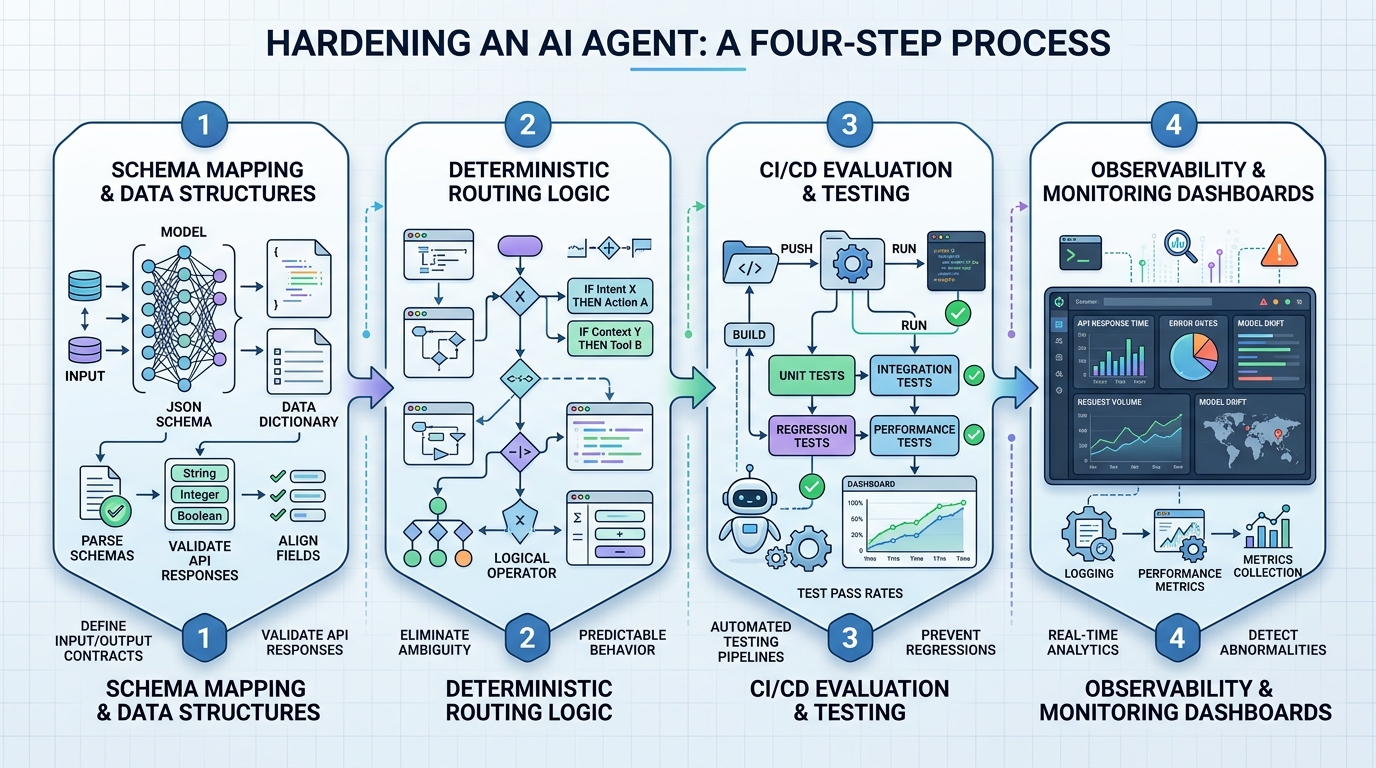
Step 1: Replace Raw Prompts with Version-Controlled Templates
Hardcoded prompts scattered across your codebase are a primary cause of architectural decay. If a junior developer modifies a prompt string in one file, it can break upstream agents in unexpected ways.
- Action: Decouple your prompts from your application code. Use specialized tooling (like LangFuse, PromptLayer, or Git repositories) to manage, version, and trace prompt configurations. Treat prompts like database schemas: any change requires a code review, a version bump, and automated testing.
Step 2: Implement a Deterministic Orchestrator
Instead of letting a single agent decide everything (which tool to run, how to process the data, and what to say next), break the workflow down into a deterministic state machine.
- Action: Use frameworks like LangGraph, Temporal, or custom state routers to control the macro-level transition states of your application. Let the LLM make local micro-decisions (e.g., extracting values, classifying text, or choosing between two discrete paths), but keep the overall system flow governed by rigid, code-first logic.
Step 3: Set Up Automated Evaluation Suites
You cannot manage what you do not measure. In traditional software, we write unit tests. In agentic software, we write evaluation suites (Evals).
- Action: Build a static golden dataset representing key user scenarios, edge cases, and known failure modes. Run these datasets through your agent pipeline as part of your CI/CD pipeline. Use an LLM-as-a-judge or semantic distance metrics to evaluate if a prompt update or model upgrade has degraded the quality of your system's outputs.
Related Reading
To learn more about optimizing and architecting high-performance, secure agentic pipelines, check out these deep-dive resources:
Enjoyed this article? Join the Growency newsletter
Practical AI tips for service businesses, straight to your inbox. No spam, unsubscribe anytime.